
1944 Wedding and Escape
By early 1944, as the strategic situation deteriorated across the European theater, Ernst Großmann and Ilse Wansky secured official military authorization to marry on January 2. Granted leave from Flak-Abteilung 402, Großmann traveled with Wansky from the Channel coast across the Reich to Lower Silesia, traversing a continental railway network that remained functional despite mounting Allied air interdiction. On January 17, 1944, they were married at St. Hedwig’s Church in Grünberg (now Zielona Góra, Poland).
Großmann’s father and two sisters traveled from southern Germany to attend the service. For the wedding meal, Ilse’s brother Gunther, an infantryman wounded on the Eastern Front, procured venison and wine. This domestic celebration stood in direct, jarring juxtaposition to the brutal realities of the surrounding municipality. In Grünberg, hundreds of Jewish women held in local forced labor camps were being systematically starved and exploited in textile and manufacturing facilities, producing uniforms for the Wehrmacht under devastating conditions.
The wartime respite was brief. On January 21, air raid sirens in Silesia disrupted the post-wedding period, signaling the expanding reach of Allied air operations. By January 26, Großmann had completed the return journey to his duty station in the occupied West; the following day, his diary recorded an Allied Hawker Typhoon shot down by his anti-aircraft unit.


Ernst and Ilse entering St. Hedwig's Cathedral on their wedding day. Silesia was luckily outside the range of the bombers and remained unscathed until the Soviets took it in 1945. That was little consolation to the numerous prisoners of the Nazis in the various labor camps nearby.
In March 1944, Großmann reported to Flakartillerieschule 11 on the Baltic coast in Barth for technical instruction on the FuMG 64 Mannheim radar—a significant electronic upgrade to the standard Würzburg system. Equipped with automated conical scanning and improved target-acquisition circuitry, the Mannheim transmitted firing coordinates directly into the Kommandogerät (electro-mechanical fire-control director) of heavy 8.8 cm Flak batteries, enabling precise "blind-fire" engagements of Allied aircraft through thick cloud cover and at night. Barth was also the site of Stalag Luft I, an Allied aircrew prisoner-of-war camp, placing Luftwaffe gunnery training in immediate physical proximity to captured airmen.
By April, Großmann was deployed to radar evaluation and data-fusion centers in Antwerp and Liège. There, operators worked to filter incoming signal interference and triangulate Allied bomber formations through dense corridors of "Window"—the metallic foil chaff deployed by the Royal Air Force and USAAF to blind German radar networks.
During this assignment, Großmann traveled to Lille after receiving word that Ilse was hospitalized; the illness was confirmed to be severe morning sickness. In accordance with military regulations regarding pregnant personnel, Ilse was discharged from signals service to return to the Reich. Utilizing accumulated leave from his radar training course, Großmann accompanied her back to Grünberg, Silesia. On his return transit to the Western Front, he made a brief stop in his hometown of Kirchheim unter Teck. His departure on May 4, 1944, would be his final visit home until after the end of the war.
Ilse with her family in Grünberg. Her sister Liesbeth with husband Alois, Ilse in uniform, her mother Elizabeth, and her sister Margot. Margot worked in a munitions factory during the war and Alois was a soldier with PTSD who would take his life after the war.

D-Day and a desperate escape
On June 6, 1944, Großmann recorded: "Beginning of the landing Cherbourg to Caen,” reflecting the uncertainty of the D-Day landings even as they were underway. He was sent to Brussels to man a Mannheim radar site and his diaries take on a new intensity, “Mustangs overhead,” “JABO" (slang for fighter-bombers like the P-47 Thunderbolt), “Heavy strikes in the square.” He was sent to Laon, France as part of the defense of the railyards supporting the movement of Panzer Lehr to reinforce the invasion front as B-26s of the 9th Air Force pummeled the city. Day by day his entries note outages of the radar net and the frenzied work of technicians to bring them back online. It was all on the verge of collapse.
The Allied breakout from Normandy (Operation Cobra) in late July and the subsequent landings in Southern France (Operation Dragoon) in mid-August precipitated the general collapse of the Wehrmacht in the West. By mid-August, the German 7th Army was being crushed in the Falaise Pocket. The retreat from Laon marks the first of Großmann’s lucky escapes. The US 3rd Armored Division, commanded by Major General Maurice Rose, liberated Soissons on August 28 the same day Ernst left Laon. The two cities are only a half hour drive in peacetime and Laon was liberated two days later on the 30th. Any delay would have meant death or capture and his escape route kept his unit just ahead of the US VII Corps' right hook.

The entry from Ernst's diary shows that on D-Day he wrote, "Beginning of the landings Cherbourg to Caen."
Großmann’s diary provides a vivid, day-by-day itinerary of the chaotic retreat that followed as his diary becomes filled with notes on “JABO,” or fighter-bombers making travel perilous as the Thunderbolts and Mustangs struck from the sky. After Paris was liberated his route indicates a desperate flight to escape encirclement. This movement—Laon to Hirson to Nivelles to Maastricht—is a straight line northeast, away from the enveloping Allied pincers. The speed of this movement (over 200 kilometers in under a week) confirms that Flak Abteilung 402 was fleeing rather than conducting a fighting withdrawal.
Ernst's second escape war occurred during the first days of September 1944. As German units retreated towards Belgium, they were funneled into a choke point around Mons. The US First Army, anticipating this, swung north to block the exit, creating the "Mons Pocket."
Between August 31 and September 5, 1944, the US 1st Infantry Division and 3rd Armored Division encircled approximately 70,000 German troops near Mons. The trapped forces were disorganized, consisting of retreating infantry columns, Flak units, and logistical trains. The battle resulted in 3,500 German dead and 25,000 prisoners. Großmann’s unit was just ahead of the US encirclement; however, he faced a secondary threat: The British Guards Armoured Division was advancing rapidly towards Brussels on this exact timeline. Ernst departed Nivelles for Maastricht on the afternoon of September 2. This timing was critical. Had he remained in the Nivelles/Brussels area for 12–24 hours longer, he would have been intercepted by the British vanguard entering the capital. His movement to Maastricht placed him behind the Meuse River/Albert Canal line, a temporary haven as the Allied advance paused for logistics. The Guards liberated Brussels on September 3, 1944. By September 3 Großmann was reassigned to Cologne and his days as an occupier ended.
In mid-September, he was transferred to the 7th Flak Division, headquartered in Cologne. This division was responsible for defending one of the most critical industrial sectors of the Third Reich: the Rhineland-Ruhr area. Assigned to defend the area around Cologne, Brühl, and Wesseling he was defending the massive synthetic fuel plants that kept the last bit of the Wehrmacht running. He notes the intensity of the fight:
-
Oct 7: "11 Thunderbolts, 1 very close."
-
Oct 11: "Massive strikes Wesseling, 1 4-engine bomber shot down"
-
Oct 30: "Night strike Cologne... Radars fail"
-
On December 4, 1944, amidst the chaos of “lively days” under the bombs on the front, his daughter Notburga was born. Due to the chaos of the war he wouldn’t find out for days. Now he was fighting to get back to his wife and the daughter he had never met. Little did he know they were in as much danger as he was.
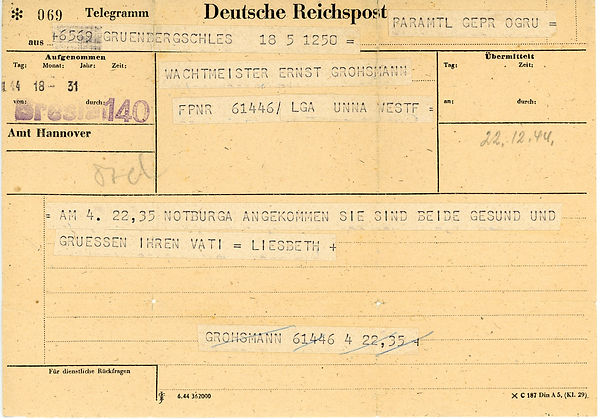
This is the telegram notifying Ernst of his daughter's birth, "On the 4th at 10:35 Notburga arrived she is both healthy and greets her father." It was sent by Ilse's sister Liesbeth from Breslau to Ernst at Feldpost Number 61446 corresponding to 6 Batterie schwere Flak-Abteilung 331 in Brühl-Wesseling sitting between Cologne and Bonn.

Ernst & Ilse on their wedding day, January 17, 1944


Großmann