The War Diaries and Photography of
Ernst Großmann
Opa's War
Explore the experiences of a Luftwaffe Flak soldier and a signals Helferin through diaries and photographs from World War II.
Wachtmeister Ernst Großmann
Opa’s War derives its title from the German word for grandfather, referencing die Kriegsgeneration—the wartime generation whose private papers, domestic albums, and vernacular records offer a ground-level lens into the Second World War. At the center of this archive is the personal collection of Ernst Großmann, who maintained an extensive daily diary and compiled a visual record of over 1,000 photographs and original negatives between 1937 and 1945. His materials provide an unusually granular examination of service within the German Luftwaffe, tracing its pre-war expansion, the 1940 Western Campaign, and the final collapse of 1945.
This archive documents the service records, diaries, and candid photography of Wachtmeister Ernst Großmann and Signals Auxiliary Ilse Wansky provide a primary source perspective on everyday life within the German military apparatus during the Second World War. While the collection captures daily routines, technical duties, and personal experiences, it is presented with full recognition of the criminal nature of the regime they served.
-
The Reality of Occupation: The Wehrmacht and Luftwaffe were the primary instruments of a brutal war of aggression, mass atrocities, and the Holocaust. During their deployments in occupied France and Belgium, German military personnel operated as occupiers, benefiting from security, material comforts, and leisure denied to the subjugated local populations who endured severe oppression, exploitation, and terror.
-
Parallel Trajectories of the War’s End: In January 1945, the Wansky family evacuated westward from Grünberg (Lower Silesia) to escape advancing Soviet forces. Grünberg was the site of a major subcamp of the Gross-Rosen concentration camp system. The family’s civilian flight ran parallel to and directly through the deadly evacuation marches of thousands of concentration camp prisoners forced through the exact same territory.

Großmann’s trajectory reflects the technical and operational realities experienced by many within this cohort. Initially assigned to frontline assault units preparing for the first wave of Operation Sealion (the aborted invasion of Great Britain), he was subsequently reassigned to radar school. For the remainder of the war, he served as a Wachtmeister (Sergeant 1st Class), operating early radar systems to track Allied bomber formations and direct anti-aircraft (Flak) batteries across occupied Western Europe. It was during his deployment in occupied France that he met Ilse Wansky, a former Red Cross nurse serving as a German Army Signals auxiliary (Nachrichtenhelferin). Yet they were occupiers supporting a brutal regime. This site attempts to view their service with that reality in mind.
Opa’s War is a digital microhistory archive designed to examine the Second World War through the intersection of personal experience and global catastrophe. By contextualizing the private diaries, field logs, and candid photographs of Luftwaffe Wachtmeister Ernst Großmann the project investigates how everyday individuals were mobilized into and functioned within the machinery of the Third Reich.

Ilse Wansky, Ernst's wife, began the war as a nurse in the German Red Cross
The publication and analysis of these materials is intended strictly for historical research, public education, and critical reflection. This project does not romanticize military service in the Third Reich, excuse individual complicity, or minimize the catastrophic suffering inflicted upon the millions of victims of the Nazi state and its armed forces.
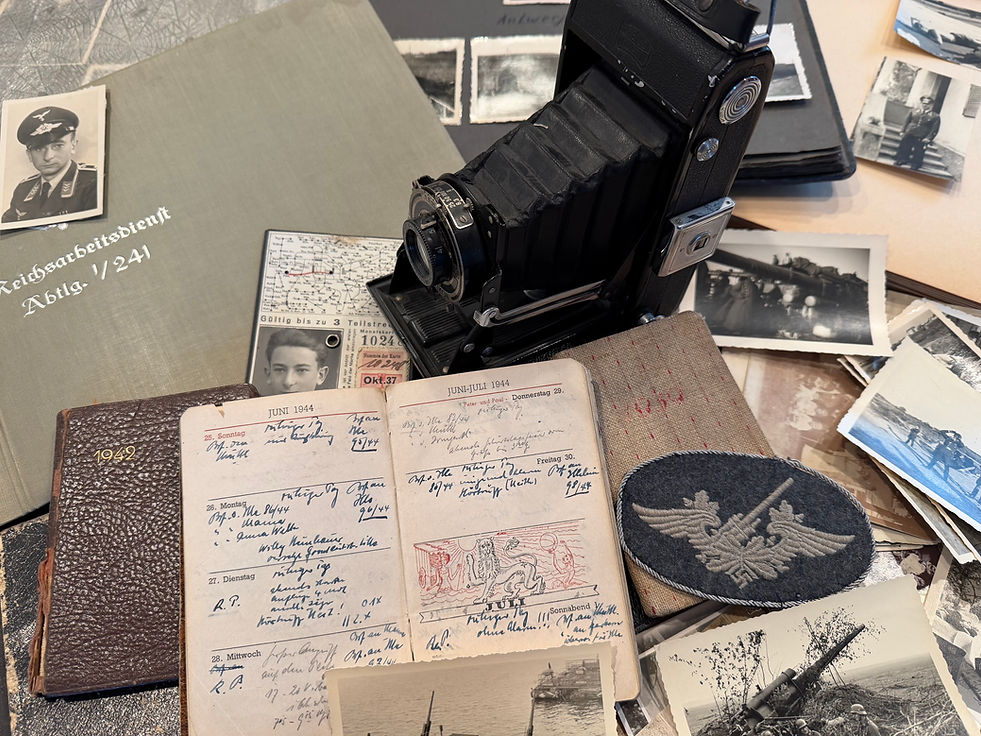
Ernst Großmann's Zeiss Ikon camera, diaries, and some of his photos
Archival Methodology & Preservation
This digital archive presents transcribed diary entries, digitized medium-format prints, and 35mm film negatives to reconstruct the operational trajectory and daily routine of these two service members.
-
Paleographic Reconstruction: Großmann’s pocket diaries—spanning 1937 through 1945 (with the 1938 volume lost)—were written in a dense, difficult cursive script. The original text underwent painstaking paleographic transcription in collaboration with German handwriting specialists at Zeit-Einblicke before being translated into English.
-
Geographical & Photographic Indexing: Hundreds of original photographic prints, frequently annotated with dates and field post numbers on their reverse, have been matched to contemporary maps, unit movement maps, and archival battle orders, such as Project44.
-
Expanding Digital Negative Archive: The project is continuously updated as new high-resolution scans from several hundred recently recovered original negatives are indexed, contextualized, and published.
Archival Origin: The Kirchheim Collection
Like countless records across post-war Germany, this archive began not in an institution, but inside a cabinet in the southern German town of Kirchheim unter Teck. Preserved in chaotic bundles of curled, scalloped-edge prints, private photo albums, and pocket journals, these artifacts remained untouched for decades.
The story documented in these drawers is not one of high command or grand military strategy. It is a microhistory of ordinary individuals—a dental student and a nurse swept into the destructive machinery of the twentieth century. Through Ernst Großmann’s daily logs and field camera, the collection traces the war from the pre-war annexations through the occupation of Western Europe to the final ruins of 1945.